
Epoxy vs. Polyaspartic Garage Floors in Sarasota — Which One Actually Survives Florida Heat?
Hot tires. Gulf Coast humidity. UV-10 exposure 8 months a year. Most garage floor coatings in Sarasota aren't built for any of it. Here's the real comparison — from someone who's seen both systems fail and succeed in this climate.
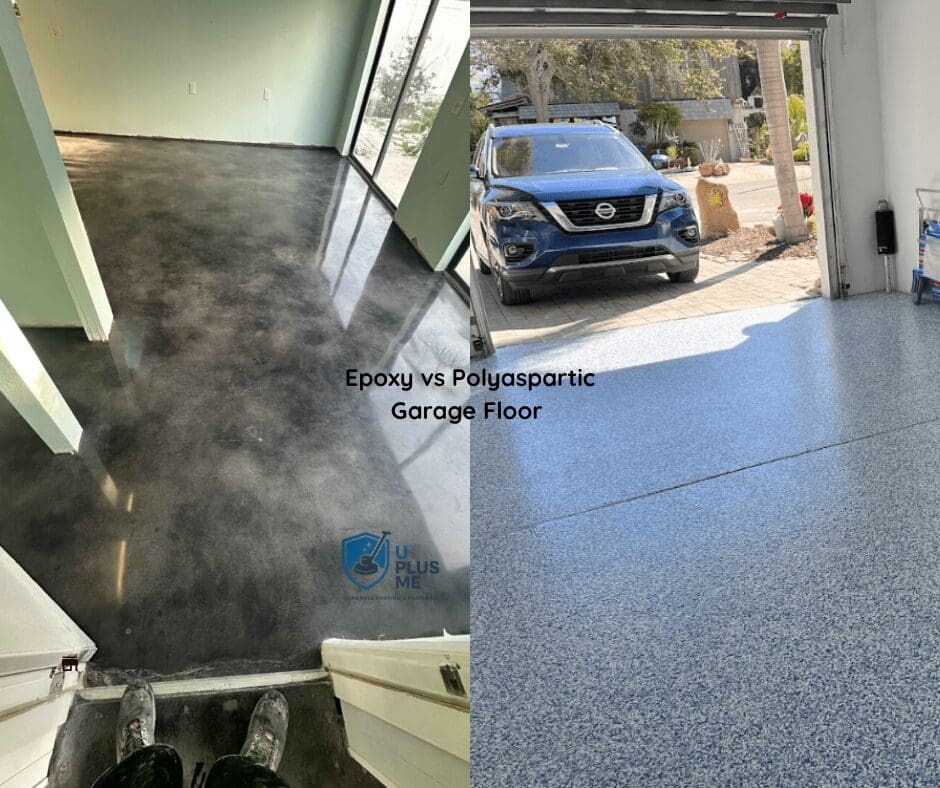
Polyaspartic lifespan: 10–20 yrs
Why Garage Coatings Fail Faster in Sarasota Than Most Places
Specialist: Michael McIntire — Owner, U Plus Me LLC · Garage Floor & Concrete Coating Expert
Service Area: Sarasota · Bradenton · Lakewood Ranch · Venice · Osprey · Nokomis · Longboat Key · Parrish · Manatee County
Phone: (941) 269-3362
Specialty: Polyaspartic Garage Floors · Epoxy Coatings · Decorative Flake Systems · Moisture Vapor Mitigation · Florida Garage Resurfacing
Garage floor coatings installed in Sarasota face a combination of stressors that almost no other region deals with simultaneously: sustained UV-10 exposure near the garage door opening, slab moisture from one of the highest water tables in the continental US, thermal cycling that swings the concrete surface from cool morning temps to 120°F+ by afternoon, and hot tires making direct contact with that thermally stressed coating twice a day, every day.
Any one of those factors alone would be manageable. All four together — and the average garage floor coating that looked great in a showroom doesn't survive to year three.
In Sarasota's grid, west-facing garages absorb full afternoon Gulf Coast sun from about 1pm until sunset — often 5–6 hours of concentrated UV and radiant heat beating into both the door opening and the slab. The concrete stores that thermal energy, and the coating sitting on top is the first thing that pays the price. This configuration is where we see the fastest UV yellowing, the highest incidence of hot-tire pickup, and the earliest delamination — especially in Palmer Ranch, the West of Trail neighborhoods, and waterfront communities facing Sarasota Bay.
Pre-2000 construction in Sarasota and Bradenton often features thinner slabs, older concrete mixes with higher porosity, and expansion joints that have moved significantly over 20+ years of Gulf Coast thermal cycling. These slabs are not the same substrate as a freshly poured slab in a new Lakewood Ranch development — and they shouldn't be treated the same way by the installer. The prep sequence, crack stabilization approach, and product selection all need to account for what's actually there, not an idealized surface.
I'm called to fix failed garage floors across Sarasota and Manatee County regularly. The majority of what I see follows one of three patterns: homeowners who did a box-store epoxy kit that looked fine for eight months and started peeling at the perimeter by summer; homeowners who hired a low-bid installer who acid-etched instead of grinding, skipped moisture testing, and left them with a coating that bubbled within a season; or homeowners who hired someone who used aromatic epoxy near the garage door and watched it amber into a yellow-brown within two years. All three of these outcomes are completely avoidable with the right process and the right product chemistry for this specific climate.
— Michael McIntire, Owner & Lead Concrete Coating Specialist, U Plus Me LLCWhat Cheap Epoxy Kits, DIY Systems & Low-Bid Contractors Do Wrong
Before we get into the technical comparison between epoxy and polyaspartic, it's worth being direct about the version of "garage floor coating" that fails most often in Sarasota — because it's the version most people encounter first when they start researching this topic online.
The $80 kit at Home Depot or Lowe's contains water-based epoxy at roughly 40–50% solids content. It's designed to be easy to apply, not to perform under Florida UV and thermal cycling. The thin film bonds adequately for the first season, then the lack of UV-stable chemistry causes it to chalk and yellow. By summer two, it's peeling at the perimeter — usually starting at the cracks and expansion joints that were never properly addressed. We remove these weekly across Sarasota.
A distressing number of installers in this market still use muriatic acid etching as their primary surface preparation method. In controlled conditions on a perfectly clean, uncontaminated slab, acid etching can open the surface marginally. In a real Sarasota garage — with oil drips, existing sealer residue, old paint, or any prior coating — acid etching produces an inconsistent surface profile that fails to provide the mechanical bond needed to survive Florida thermal cycling. Diamond grinding is not optional; it's the difference between a 2-year bond and a 15-year bond.
Florida's water table sits alarmingly close to grade in much of Sarasota and Manatee County. Concrete slabs breathe year-round — moisture vapor rises through the slab and, when it encounters a non-breathable coating without a vapor barrier, it pushes that coating up from below. The result is bubbling, delamination, and peeling that originates from underneath — not from surface wear. This failure mode is almost always invisible until the coating is already coming apart, and it's entirely preventable with a single vapor emission test before any product is selected.
Aromatic epoxy resins — the chemistry in the vast majority of budget garage floor systems — are not UV-stable. They amber and yellow under sustained UV exposure at a rate proportional to how much sun they receive. A garage door opening in Sarasota receives concentrated UV from roughly 8am until sunset. Aromatic epoxy near that opening doesn't yellow gradually — it turns visibly brown-yellow within 18–24 months. It's not a product defect. It's the wrong product for the application.
Ask every installer specifically: "Are you using aromatic or aliphatic chemistry in the topcoat?" If they pause, look uncertain, or say "it's the same thing" — that's your answer. Ask whether they're diamond grinding or acid etching. Ask whether they're testing for moisture vapor emission. If the answers to any of those questions are wrong, walk away — regardless of the price. A low-cost installation that fails in 18 months costs more than a correct installation that lasts 15 years.
📌 Also seeing issues with your pool deck or driveway? The same moisture vapor and UV degradation dynamics that destroy garage coatings affect all outdoor concrete surfaces. Our guide on heat-reflective pool deck coatings for Sarasota and Bradenton covers the same failure patterns with the same solution framework.
Epoxy vs. Polyaspartic: The Real Chemical Difference
Most homeowners think of epoxy and polyaspartic as variations of the same product — just different brand names for "garage floor coating." They're chemically distinct systems with different resin architectures, different curing mechanisms, and meaningfully different performance profiles under Florida conditions.
Aliphatic Polyaspartic System
Polyaspartic coatings are aliphatic polyurea-based systems originally developed for industrial bridge and pipeline applications requiring UV stability, rapid cure, and extreme abrasion resistance. The aliphatic molecular structure means the carbon chains are arranged to resist UV degradation — they don't yellow or chalk under sustained sun exposure because the chemistry was designed to tolerate it.
In a Sarasota or Bradenton garage, this translates to: no ambering near the door, no thermal softening under hot tires, and no moisture-related failure when properly combined with a vapor barrier on a tested slab.
- UV-stable from base coat to topcoat — no yellowing at door opening
- Cures in ~24 hours — vehicle traffic next day
- Harder cure = better hot-tire resistance
- Flexible enough to accommodate Florida thermal cycling
- Abrasion and chemical resistant — handles salt, oil, cleaning agents
Professional Epoxy System
Professional-grade 100% solids epoxy — not the box-store kit — is a legitimate coating for Florida garages in the right configuration. Interior garages with minimal UV exposure, fully shaded slabs, or properties where budget is the primary constraint can perform well with a professional epoxy system. The distinction is always: professional product, diamond grinding prep, moisture vapor testing, and an aliphatic polyaspartic topcoat to protect the epoxy base from UV.
The problem is that most of what's sold as "epoxy garage floors" in this market is not professional-grade. It's aromatic resin at partial solids, applied by someone who etched instead of ground the slab.
- Strong adhesion when properly prepped and applied
- Good chemical resistance at 100% solids formulations
- Requires UV-stable aliphatic topcoat to prevent yellowing
- 3–7 day cure before vehicle traffic
💡 The honest verdict: A professionally applied 100% solids epoxy with an aliphatic polyaspartic topcoat, over a properly diamond-ground and moisture-tested slab, is a legitimate 7–10-year Florida garage floor. A full polyaspartic system from base to topcoat, with the same prep, reaches 10–20 years. The additional cost of the polyaspartic system usually amounts to less than the cost of one premature replacement — which is the more likely outcome if the wrong system was installed in the first place.
🔗 Related guide: See our detailed breakdown of polyaspartic garage floor systems for Sarasota homeowners — including decorative flake options, color selection for heat performance, and what the installation timeline actually looks like for a two-car garage in this climate.
🔍 Not Sure Which System Your Garage Needs?
If you've already had one coating fail — or you're about to invest and don't want to repeat someone else's mistake — a free evaluation is the right first step.
We assess your slab's moisture, existing coating condition, sun exposure, and usage before recommending anything. If a mid-grade system solves your problem, that's what we'll tell you.
Serving Sarasota · Bradenton · Lakewood Ranch · Venice · Osprey · Longboat Key · Parrish · Manatee County
⏰ Summer booking fills weeks ahead — evaluation slots open now.Hot-Tire Pickup: The Failure Mode Sarasota Homeowners Don't Expect
Hot-tire pickup is exactly what it sounds like: a hot vehicle tire contacts a thermally softened coating, and when the car backs out, it takes part of the coating with it. The failure pattern typically shows up as lifting, peeling, or tire-track-shaped marks near the front of the parking bay — and it almost exclusively happens in the first few years of a weaker coating's life.
In Sarasota, this failure is dramatically more common than in northern climates because the thermal chain that causes it runs much hotter. A vehicle parked in an un-air-conditioned Sarasota garage on a July afternoon can have tire temperatures of 130–160°F when it pulls back in from a short errand. If the coating beneath that tire has softened to 100–110°F due to slab temperature and has any adhesion weakness — from poor prep, moisture issues, or inferior chemistry — the contact and shear of backing out is enough to begin delamination.
Three Years of Hot-Tire Damage — Fixed in One Correct Installation
A homeowner in Lakewood Ranch contacted us after the epoxy floor in their two-car garage had been peeling progressively since year two. The garage faced west, received full afternoon sun through the double-door opening, and had been installed by a company that used acid etching and an aromatic epoxy system. The coating near the door opening was visibly yellowed; both parking bays showed significant hot-tire lifting in the front third of each space.
We stripped the failed system via diamond grinding down to bare concrete, tested for high moisture vapor emission (confirmed — vapor barrier required), repaired two expansion joint cracks, and installed a full polyaspartic system with decorative chip broadcast and aliphatic topcoat. The installation completed in one day; the garage was back to vehicle use in 24 hours.
The system has been in service through two full Florida summer cycles with zero hot-tire marks, no yellowing at the door, and no edge peeling.
One correct installation replaced three years of progressive failure⚠️ The DIY garage floor trap: The homeowner who installs a box-store epoxy kit on a Saturday in March will typically be happy with it until June or July — when the slab heats up for the first time and the tires start doing their work. By the following spring, the floor looks worse than it did before. This is the sequence we see repeatedly across Sarasota, Bradenton, and the Lakewood Ranch communities. The kit was not a bargain; it was a two-year rental of the appearance of a finished floor.
Head-to-Head: Epoxy vs. Polyaspartic Performance Data for Florida Garages
This comparison covers professional-grade systems only — not store kits, which are in a separate category of expected performance. If you're evaluating professional epoxy vs. professional polyaspartic for a Sarasota or Bradenton garage, here's the honest breakdown.
| Performance Factor | Professional Epoxy | Aliphatic Polyaspartic |
|---|---|---|
| UV Resistance (near garage door) | Moderate — requires aliphatic topcoat | Excellent — stable from base to finish |
| Hot-Tire Pickup Resistance | Good with proper prep; weaker under sustained heat | Excellent — cures harder, resists thermal softening |
| Moisture Vapor Tolerance | Moderate — vapor barrier often required in FL | High — combined with vapor barrier as needed |
| Cure Time (return to vehicle traffic) | 3–7 days minimum | ~24 hours |
| Yellowing / Ambering Risk | High with aromatic chemistry; mitigated by aliphatic topcoat | None — aliphatic chemistry throughout |
| Thermal Flexibility | Can become brittle under repeated FL heat cycles | Engineered for thermal flexibility — moves with the slab |
| Typical Florida Lifespan | 3–10 years (wide range based on product & prep) | 10–20 years with correct installation |
| Best Situation in Sarasota | Interior/shaded garages; budget-priority projects | West-facing, sun-exposed, waterfront, long-term value |
| 💡 In both systems, installation quality — surface profiling, moisture testing, correct product chemistry — is the most significant variable determining how close the actual lifespan comes to the theoretical maximum. | ||
🔗 Planning a broader renovation? Our guide on decorative concrete coating options in Florida covers how these same system choices apply to driveways, lanais, and pool decks — and why the selection criteria overlap significantly across all outdoor concrete surfaces in the Gulf Coast climate.
Sarasota & Bradenton: How Local Conditions Change the Right Answer
The Gulf Coast isn't one uniform environment, and the right garage floor system for a home in Osprey is not necessarily the same as the right system for a new build in Lakewood Ranch. Here's how local geography and neighborhood context affect the recommendation:
Maximum UV and thermal exposure. These are the garages where an aromatic epoxy system yellows fastest, where hot-tire pickup is most common, and where the difference between a correct and an incorrect installation is most visible within the first two summers. For these locations, full polyaspartic from base to topcoat is not a premium upgrade — it's the appropriate system for the actual exposure conditions.
Newer concrete in Lakewood Ranch developments typically has better moisture control than older Sarasota slabs, but HOA-adjacent properties have appearance standards that make yellowing and peeling even less tolerable. The decorative chip broadcast polyaspartic system is the dominant choice in this community — it meets aesthetic expectations and performs reliably under the west-exposure conditions common to Lakewood Ranch's grid layout.
Properties within a mile or two of the Gulf or bay experience elevated salt air concentration that accelerates coating oxidation in systems not rated for coastal exposure. The same aliphatic polyaspartic chemistry that resists UV yellowing also tolerates salt air significantly better than aromatic epoxy. For coastal-adjacent properties, marine-rated topcoat specification is our standard recommendation.
Older concrete slabs in established Sarasota neighborhoods — Southside Village, Gillespie Park, historic East Side — have moved significantly over 25+ years of thermal cycling. Expansion joints have widened, hairline cracking is common, and surface porosity is higher than in newer pours. These slabs need flexible polymer crack fillers, vapor barrier assessment, and potentially more extensive grinding than a newer slab. The coating product matters less than acknowledging what's actually underneath it.
Our Installation Process — What We Do That Most Contractors Skip
At U Plus Me, every garage floor installation follows the same structured preparation sequence — regardless of whether the homeowner chooses epoxy or polyaspartic. The product applied on top is only as good as what happens to the concrete before it.
We test every slab before selecting a system. Florida's water table and humidity mean many slabs have higher moisture vapor emission than they appear. This single step determines whether a vapor barrier is needed and which coating chemistry is appropriate.
We use industrial diamond grinders to achieve a Concrete Surface Profile (CSP 2–3) — the specification required for proper mechanical adhesion of professional coating systems. This removes old sealers, contaminants, and weak surface layers, and opens the concrete pore structure for the coating to root into.
All cracks and expansion joints are repaired with flexible polyurea joint filler — not rigid cement patch. The filler accommodates the thermal movement of Florida concrete without re-cracking, which rigid patches cannot do. Coating over unrepaired cracks delays the problem briefly and then amplifies it.
If moisture vapor emission exceeds acceptable thresholds, we install a moisture vapor barrier as part of the system before any base coat is applied. This is non-negotiable for slabs that test above threshold — and it's the step most budget installers skip because it adds time and cost to the estimate.
The system-specific base coat is applied and decorative vinyl chips are broadcast to refusal — full, even coverage that creates the wear layer and appearance. The chip profile is selected based on aesthetic preference and traction requirements for your specific garage usage.
The final protective layer — aliphatic chemistry, UV-stable, abrasion and chemical resistant. For full polyaspartic systems this is the cap of a UV-stable stack. For epoxy base systems, this topcoat is what prevents the underlying epoxy from yellowing near the door opening.
A peeling or bubbling garage floor in Sarasota's climate doesn't stabilize — it accelerates. Every rainy season drives more moisture into delaminated areas; every hot Florida summer expands the failure zone. The difference in repair cost between catching it early and addressing it after a full annual cycle of Florida weather is significant.
Every qualifying installation includes a 2-year workmanship warranty on adhesion and delamination. We can offer this because we control the process: moisture testing, mechanical prep, product chemistry, and application conditions. A contractor who can't explain what they're controlling can't offer a meaningful warranty.
🏆 Stop Paying for Garage Floors That Fail Before They Should
You shouldn't be replacing a garage floor coating every three years. The right system, correctly installed, is a decade-plus investment — not an annual frustration.
Free evaluation. Honest assessment. Written itemized estimate. No pressure to choose the most expensive option if a simpler system is the right fit.
Sarasota · Bradenton · Lakewood Ranch · Venice · Osprey · Nokomis · Longboat Key · Parrish · Manatee County
📅 Summer booking fills fast — evaluation slots open now but close quickly in peak season.❓ Frequently Asked Questions
Are polyaspartic garage floors worth the additional cost in Sarasota?
For most Sarasota and Bradenton garages — especially west-facing or sun-exposed slabs — yes. The lifespan difference between a professional polyaspartic system (10–20 years) and a professional epoxy system (7–10 years) in Florida's climate means fewer replacements over the ownership life of the home. When you factor in the labor and materials cost of one additional replacement cycle, the premium for polyaspartic typically pays for itself before the second replacement would have been needed.
What is hot-tire pickup and why does it happen in Florida garages specifically?
Hot-tire pickup occurs when a thermally softened coating can't withstand the shear force of a hot tire backing off the slab. It's more common in Florida than elsewhere because Sarasota garage slabs reach temperatures that soften weaker coating systems before the car even arrives — and vehicle tires returning from a short errand in July can carry heat of 130–160°F. The combination of a hot slab and hot tires exceeds the thermal resistance threshold of many epoxy systems, especially ones applied over inadequately prepped concrete. Polyaspartic coatings cure significantly harder and resist this failure mode better.
Why does my epoxy garage floor keep yellowing near the door?
This is one of the most common complaints we hear across Sarasota and Manatee County. Aromatic epoxy resins — the chemistry in most budget garage floor products — are not UV-stable. The "aromatic" designation refers to ring-structure carbon chains that break down under UV exposure, producing visible yellowing and ambering. The concentration of UV at a garage door opening, where sunlight enters at low angles for extended periods, makes this the most affected area. The fix is an aliphatic topcoat — which, if it should have been specified from the start, could have prevented the yellowing entirely.
Why did my garage floor start bubbling after only one summer?
Bubbling that appears within the first season is almost always moisture vapor pressure — water rising through the concrete slab and breaking the coating bond from below. Florida slabs are particularly vulnerable because of the high water table and year-round humidity. The failure is not the coating product; it's the missing moisture vapor test and vapor barrier that should have been part of the installation. This failure is fully preventable with proper preparation.
How long do I have to wait before parking on a new garage floor?
Professional polyaspartic systems typically allow vehicle traffic in approximately 24 hours. Professional epoxy requires 3–7 days. In Florida, where extended cure windows expose a fresh coating to outdoor humidity, the faster cure of polyaspartic is a practical advantage — less time for environmental conditions to interfere with the curing system.
Does U Plus Me install garage floor coatings in Sarasota, Bradenton, Venice, and nearby areas?
Yes. We install polyaspartic and professional epoxy garage floor systems throughout Sarasota, Bradenton, Lakewood Ranch, Venice, Osprey, Nokomis, Longboat Key, Parrish, and all of Sarasota and Manatee counties. Call (941) 269-3362 or contact us online to schedule a free on-site evaluation.
Your Garage Floor Should Last a Decade — Not Three Years
One correctly specified, correctly installed system in a Sarasota garage performs through 10–20 Florida summers. Stop replacing the same floor on a three-year cycle because the last installer used the wrong product or skipped the prep.
Serving Sarasota · Bradenton · Lakewood Ranch · Venice · Osprey · Nokomis · Longboat Key · Parrish and all of Sarasota & Manatee County, FL.
🔥 Book My FREE Garage Floor EvaluationOr call Michael directly: (941) 269-3362
🛡️ Free Evaluation · Written Itemized Estimate · Zero Pressure · 2-Year Warranty · Gulf Coast Garage Floor Specialists