
Don't Wait for an Accident: Slip-Resistant Pool Deck Coatings That Actually Work in Florida
A pool deck can look clean and still be unsafe. In Florida, rain, humidity, algae pressure, worn sealers, sunscreen residue, and smooth coatings can make the walking surface around a pool slick exactly when children, older adults, and guests are using it barefoot.
This guide focuses on safety, wet-foot traction, and coating systems that perform in Florida conditions. For broader design, heat, and resurfacing choices, see our full pool deck resurfacing options.
A Real Safety Wake-Up Call in Sarasota
A Sarasota homeowner contacted U Plus Me after their father slipped while walking across a wet pool deck after an afternoon thunderstorm. Fortunately, the injury was minor, but the incident exposed a serious issue: the concrete looked acceptable, yet the surface had lost the wet-foot traction needed for safe pool use.
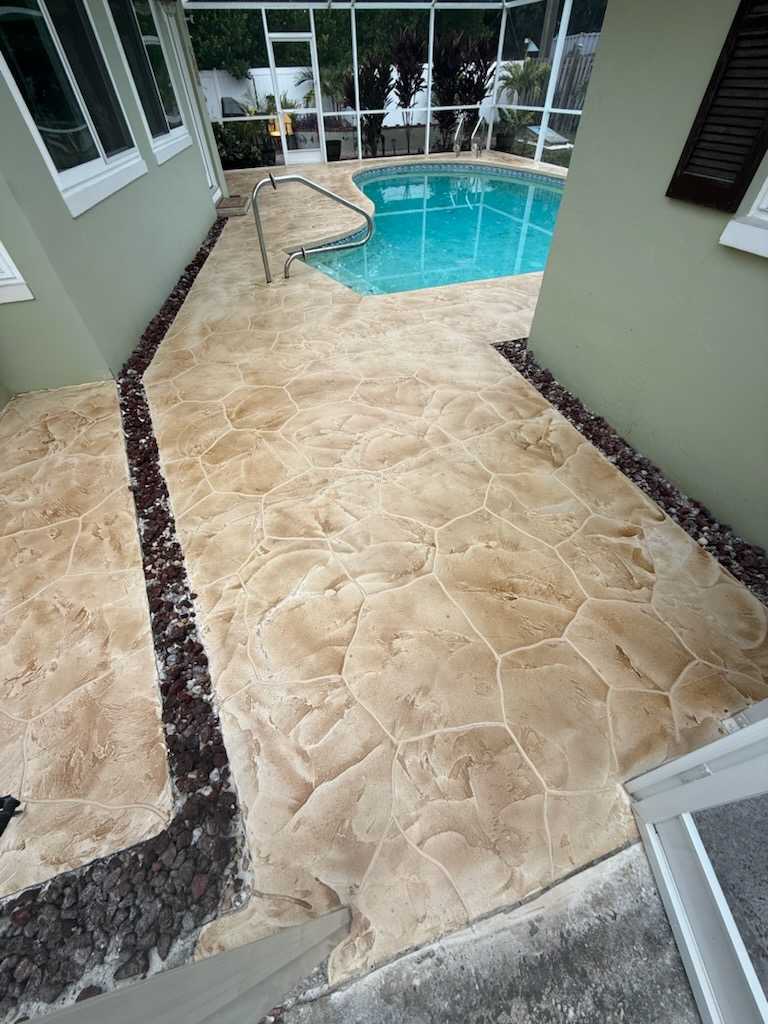
After inspecting the slab, U Plus Me recommended a slip-resistant decorative resurfacing system rather than full concrete replacement. The surface was mechanically prepared, worn coating areas were removed, minor surface defects were repaired, and a textured decorative overlay was installed with a UV-stable protective topcoat. The finished deck delivered better traction around the pool entry points, a more updated appearance, and a safer walking surface for the homeowner's father, children, and guests.
Why Florida Creates More Slip Hazards Than Other States
Florida pool decks face a unique combination of moisture, UV exposure, rain, algae pressure, pool chemicals, sunscreen residue, and year-round foot traffic. These conditions can turn smooth concrete, worn sealers, or aging decorative coatings into slick walking surfaces even when the pool deck still looks attractive.
Humidity supports algae and mildew growth, especially in shaded lanai corners, drainage edges, and screen enclosure transitions.
Afternoon storms wet the surface quickly, then Florida sun dries it unevenly, stressing coatings and exposing slick worn zones.
Sunscreen residue, chlorine splash, saltwater systems, and cleaning products can create a film that reduces traction over time.
Siesta Key, Longboat Key, and Lido Key pool decks often face airborne chlorides, elevated porosity, and moisture migration through the slab.
The technical issue is not texture alone. Slip resistance depends on surface profile, water displacement, coating chemistry, contamination control, concrete porosity, and whether the system maintains micro-texture after years of UV and wet-foot traffic.
How Dangerous Can a Slippery Pool Deck Be?
A slippery pool deck can cause more than a minor fall. Around a swimming pool, people are often barefoot, wet, distracted, carrying towels or pool accessories, or moving quickly to avoid rain. Children and older adults face higher risk because they are more vulnerable to loss of balance and impact injuries.
Pool steps, coping edges, outdoor shower areas, lanai door thresholds, furniture paths, shaded corners, and areas where water collects after storms.
Wrist, ankle, shoulder, hip, knee, and head injuries can occur when a wet surface loses traction unexpectedly.
Children may run barefoot near the pool, while older relatives may hesitate or lose confidence on surfaces that feel slick after rain.
Homeowners who entertain frequently should treat pool deck traction as a safety feature, not only a cosmetic upgrade.
Concerned about a slippery pool deck?
Schedule a free pool deck safety evaluation. U Plus Me will inspect slick zones, drainage patterns, coating wear, moisture concerns, and texture loss before recommending a slip-resistant resurfacing system.
What Makes a Pool Deck Truly Slip-Resistant?
A truly slip-resistant pool deck coating combines controlled surface texture, moisture-aware preparation, UV-stable chemistry, water drainage, and durable topcoats. The best systems improve wet-foot traction without creating a painfully rough surface that traps dirt or hurts bare feet.
"The best slip resistance comes from controlled micro-texture, not aggressive roughness. A pool deck should create enough surface friction to improve confidence when wet while still feeling comfortable for bare feet."
Michael McIntire · U Plus Me LLC| System Requirement | Why It Matters for Safety | What U Plus Me Looks For |
|---|---|---|
| Micro-texture | Creates grip points when the surface is wet. | Texture that improves traction without becoming abrasive. |
| Water displacement | Prevents thin films of water from sitting on smooth surfaces. | Drainage patterns, low spots, pool entry zones, and lanai edges. |
| UV-stable chemistry | Helps preserve texture and coating integrity under Florida sun. | Aliphatic polyaspartic or UV-stable protective systems where appropriate. |
| Moisture evaluation | Reduces risk of bubbling, peeling, or delamination. | MVT concerns, shaded wet zones, prior coating failure, and coastal moisture exposure. |
| Surface preparation | Determines whether the coating bonds and lasts. | Diamond grinding, crack treatment, and substrate verification before coating. |
Which Pool Deck Coatings Work Best in Florida?
The best coating depends on the existing concrete, safety goals, design preference, moisture conditions, and exposure level. For Florida pool environments, textured decorative overlays, cool deck coatings, and properly selected UV-stable polyaspartic systems usually outperform smooth paint or standard concrete sealers.
| Pool Deck Surface | Slip Resistance | Florida Durability | Comfort Underfoot | Best Use |
|---|---|---|---|---|
| Smooth Painted Concrete | Low | Low | Moderate | Not ideal for wet pool areas. |
| Standard Concrete Sealer | Low to Moderate | Moderate | Moderate | Appearance refresh only; traction depends on additives. |
| Acrylic Texture Systems | High | High | High | Barefoot pool areas and lanais. |
| Decorative Concrete Overlays | High | High | High | Safety plus design upgrade. |
| Cool Deck Coatings | Very High | High | Very High | Comfort-focused pool decks in full sun. |
| Textured Resurfacing Systems | Very High | Very High | High | Safety-focused renovations with worn surfaces. |
For homeowners comparing safety with comfort and heat performance, U Plus Me also recommends reviewing full pool deck resurfacing options and the best pool deck coating options for Bradenton homeowners.
Real Sarasota Safety Upgrade: From Slick After Rain to Confident Wet-Foot Traction
A Sarasota homeowner contacted U Plus Me after their father slipped on a wet pool deck following a storm. The slab was structurally sound, but the prior finish had lost texture in the main walking route between the lanai door, pool steps, and seating area.
Aging decorative concrete with worn protective coating, smoother traffic lanes, minor surface defects, and slick zones near pool entry points after rain.
The family needed better traction for an older parent, children, and guests without making the deck rough or uncomfortable for barefoot use.
U Plus Me mechanically prepared the slab, repaired minor defects, created a proper CSP 3-4 profile, and installed a textured decorative overlay with a UV-stable protective topcoat.
The homeowner reported improved confidence walking barefoot after rain, better traction near the pool entry, easier maintenance, and a refreshed resort-style finish.
Decorative slip-resistant pool deck resurfacing system installed on a Florida lanai, designed to improve traction, durability, and safety around wet pool areas.
The Substrate Preparation Process That Determines Success
Surface preparation accounts for more coating failures than coating selection itself. A slip-resistant coating must stay bonded, maintain texture, and resist moisture-related failures. That starts before the first decorative layer is applied.
Moisture evaluation identifies vapor pressure risks before installation, especially on older slabs, shaded lanais, and coastal properties.
Structural and non-structural cracks are evaluated separately so repairs are matched to the slab condition.
Diamond grinding creates a cleaner, more consistent Concrete Surface Profile than acid etching for most residential pool decks.
Cracks, spalls, worn coatings, soft edges, and damaged zones are addressed before the slip-resistant system is installed.
The slab is inspected before coating application begins to confirm adhesion readiness, drainage concerns, and texture goals.
How Much Do Slip-Resistant Pool Deck Coatings Cost in Sarasota or Bradenton?
Slip-resistant pool deck coatings in Sarasota and Bradenton commonly range from about $6 to $18+ per square foot. The final price depends on the size of the deck, surface condition, coating removal, crack repair, texture, decorative finish, moisture mitigation needs, access, and how much preparation is required.
| Project Type | Typical Cost Range | What Affects Price |
|---|---|---|
| Basic texture refresh | $6-$9 per sq. ft. | Sound concrete, minimal repairs, simple texture, limited coating removal. |
| Slip-resistant decorative resurfacing | $9-$14 per sq. ft. | Texture upgrade, decorative finish, crack treatment, UV-stable topcoat. |
| Premium safety and decorative system | $14-$18+ per sq. ft. | Extensive prep, failed coating removal, moisture concerns, custom finish, complex layout. |
A low quote that skips moisture evaluation, diamond grinding, or crack treatment can become more expensive if the coating peels, turns slick, or fails prematurely. For safety-focused projects, preparation is part of the value, not an optional extra.
Polyaspartic vs. Epoxy for Florida Pool Deck Safety Coatings
Polyaspartic systems generally outperform traditional epoxy systems for exterior Florida pool areas because they offer stronger UV stability, faster cure times, better resistance to yellowing, and improved flexibility under thermal movement. Epoxy may be suitable in certain covered spaces, but it is rarely the best choice for sun-exposed pool decks.
| Performance Factor | Polyaspartic | Epoxy |
|---|---|---|
| UV stability | Excellent | Poor to limited |
| Cure time | 2-6 hours depending on system | 24-72 hours depending on system |
| Flexibility | High | Moderate |
| Yellowing resistance | Excellent | Low |
| Exterior use in Florida | Strong candidate | Limited |
| Thermal shock resistance | High | Moderate |
Definition: An aliphatic coating is a UV-stable polyurethane or polyaspartic coating formulated to resist color change, chalking, and degradation from sunlight exposure.
Related Pool Deck Resources from U Plus Me
This article is the safety-focused page in the U Plus Me pool deck content cluster. The links below separate search intent so this page targets slip resistance, while the related pages cover full resurfacing, heat comfort, coating selection, and failure prevention.
- Learn more about full pool deck resurfacing options - service page for homeowners ready to compare resurfacing systems, coating choices, and estimate options.
- Best Pool Deck Coating Options for Bradenton Homeowners - coating comparison guide for UV stability, slip resistance, and Gulf Coast durability.
- Cool Deck Coatings and Repair in Sarasota - resurfacing resource focused on Sarasota pool deck restoration, comfort, and coating performance.
- Why Pool Deck Coatings Fail in Sarasota, FL - failure-focused guide covering peeling, bubbling, moisture intrusion, UV degradation, and poor preparation.
- Red Flags When Hiring a Pool Deck Contractor Near You - contractor selection guide for homeowners comparing estimates.
Frequently Asked Questions About Slip-Resistant Pool Deck Coatings
What is the best slip-resistant pool deck coating for Florida?
The best slip-resistant pool deck coating is usually a textured decorative overlay or UV-stable polyaspartic system installed over properly prepared concrete. The system should include moisture evaluation, diamond grinding, crack repair, controlled micro-texture, and a protective topcoat designed for Florida rain, humidity, pool chemicals, and UV exposure.
How much do slip-resistant pool deck coatings cost?
Slip-resistant pool deck coatings in Sarasota and Bradenton commonly range from about $6 to $18+ per square foot. Basic texture systems may be closer to the lower end, while failed coating removal, extensive crack repair, moisture mitigation, custom decorative finishes, and premium topcoats can increase the price.
Are slip-resistant coatings rough on bare feet?
No, not when they are designed correctly. Professional systems use controlled micro-texture to improve wet traction without creating a painfully rough surface. This balance is important for pool decks because children, older adults, guests, and pets often walk barefoot around the pool.
Can a slippery pool deck be resurfaced instead of replaced?
Yes. If the underlying concrete is stable, resurfacing can often improve safety without demolition. The existing slab can be cleaned, mechanically profiled, repaired, and resurfaced with a textured safety-focused coating system that improves traction and appearance.
Why does my pool deck feel slippery after rain?
Rain can expose worn sealers, smooth areas, algae growth, sunscreen residue, and poor drainage. If the surface no longer has enough texture to displace water, it may feel slick even if it looks clean. A professional evaluation can identify the main cause.
Is epoxy good for outdoor pool decks in Florida?
Traditional epoxy is usually not ideal for exterior Florida pool decks exposed to sunlight because it can yellow, chalk, and degrade under UV. Aliphatic polyaspartic systems and textured decorative overlays are generally better suited for sun-exposed pool environments.
How long do slip-resistant pool deck coatings last?
A professionally installed system can provide many years of performance when the concrete is properly prepared and maintained. Longevity depends on UV exposure, drainage, moisture vapor conditions, foot traffic, pool chemical exposure, cleaning habits, and coating quality.
Do you serve Sarasota, Bradenton, and barrier island communities?
Yes. U Plus Me serves Sarasota, Bradenton, Lakewood Ranch, Venice, Siesta Key, Longboat Key, Parrish, Palmetto, Manatee County, Sarasota County, and surrounding Gulf Coast communities.
Protect Your Family Before a Slip Becomes an Injury
Florida's humidity, rain, algae pressure, sunscreen residue, and intense UV exposure can turn an aging pool deck into a safety hazard. U Plus Me installs slip-resistant pool deck coating systems engineered for Sarasota and Bradenton homes, with moisture-conscious preparation, diamond grinding, durable texture, and UV-stable finishes.