
Before & After: Real Bradenton Pool Deck Resurfacing That Looks Like New
A pool deck takes more abuse than almost any other concrete surface on a property. It's wet constantly, it's baking in direct Florida sun most of the year, it gets splashed with chlorine, and bare feet are walking across it daily in the summer.
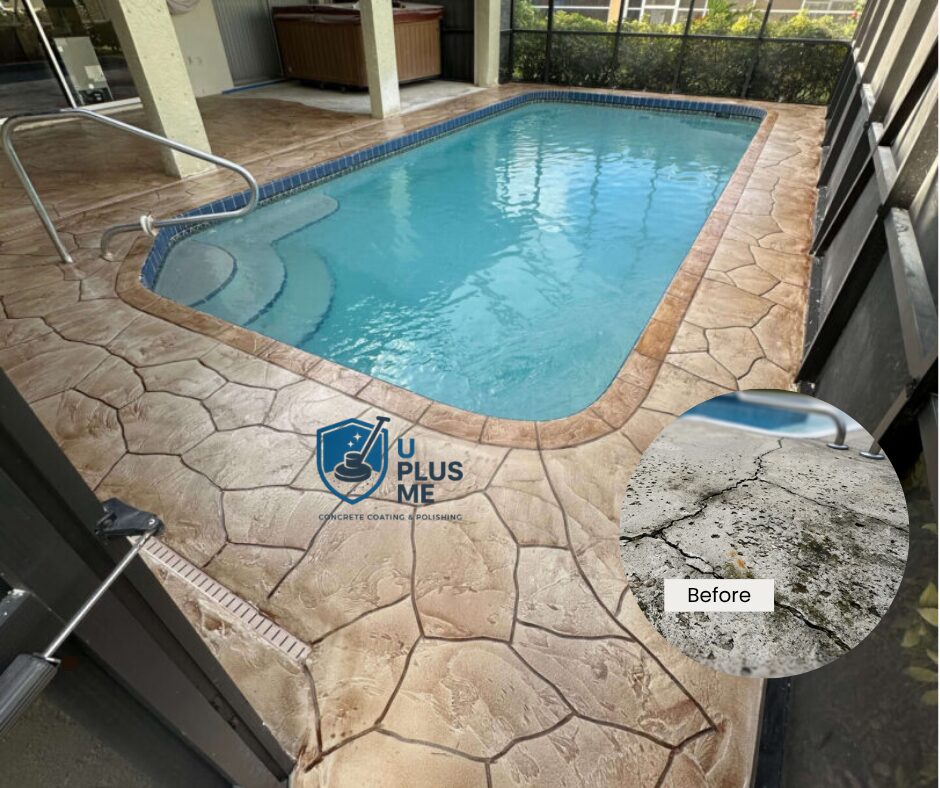
This article walks through a real local case study: what the deck looked like before we touched it, what our inspection turned up, why we prepped it the way we did, how the resurfacing was installed, and what the homeowner noticed once it was done.
Quick Summary
Pool deck resurfacing restores a cracked, faded, or slippery concrete pool deck by grinding or preparing the existing surface, repairing cracks, and applying a new textured, decorative overlay system. In this Bradenton case study, an 18-year-old pool deck with sun-bleached color, hairline cracking, and a rough, uneven texture was mechanically prepped, crack-repaired, and resurfaced with a cool-deck-style overlay in a multi-day process. The result was a deck that's cooler underfoot, more slip-resistant, visually consistent, and better suited to Florida's heat, UV exposure, and pool chemical environment than the original worn surface.
Before the Project & Initial Inspection
The deck was original to the house, poured about 18 years earlier as plain broom-finished concrete with a basic acrylic sealer, never resurfaced. Like most decks that age in the Bradenton area, sun exposure had taken a visible toll - the surface had faded to a chalky, uneven gray-white, with darker staining around the pool coping where water splashes and evaporates daily.
What we found on the initial walkthrough was typical for an original, unsurfaced Bradenton pool deck:
- UV-bleached, blotchy coloring, worse on the sun-exposed south side of the pool than the shaded side.
- Fine hairline cracking scattered across several sections, none actively moving.
- A rough, worn broom finish that had become uncomfortable and occasionally slippery when wet.
- Water staining and mineral buildup concentrated near the coping and pool edge.
- A few small spalled areas - shallow surface flaking - near a downspout where water regularly pooled.
Before quoting resurfacing work, we walk the entire deck and evaluate what's actually going on beneath the surface issues, not just what's visible. We check surface bond and soundness (sound-testing the slab for any hollow or delaminated spots), crack activity, drainage, existing sealer condition, and coping or edge transition condition.
What Problems Were Found?
The punch list from the inspection: UV-faded and uneven coloring across most of the deck, several stable hairline cracks needing repair before resurfacing, shallow surface spalling near a downspout, mineral and water staining concentrated at the coping, and a texture that had become both aesthetically dated and less slip-resistant than current pool deck finishes.
None of it required structural repair to the slab itself - which meant resurfacing, rather than a full tear-out and repour, was a realistic and cost-effective path forward.
Helpful Resource: Unsure if your deck needs a full structural replacement or a decorative overlay? Read our comprehensive comparison guide: Concrete Overlay vs Pool Deck Replacement in Sarasota & Bradenton to learn how substrate diagnostics guide long-term performance decisions.
Why Preparation Matters
The prep work is what determines whether a resurfaced pool deck looks great for a decade or starts showing problems again within a couple of years - and it's almost entirely invisible in before-and-after photos.
The existing sealer and any surface contamination had to be fully removed and the slab mechanically profiled so the new overlay material has something to properly bond to. Resurfacing over old sealer without removing it is one of the most common reasons pool deck coatings delaminate early.
Each hairline crack was routed and filled with a flexible filler rather than a rigid patch, since pool decks see constant thermal movement between hot sun exposure and cool pool water splash - a rigid filler in that environment tends to crack again at the same point.
The shallow spalled areas near the downspout were patched and leveled before resurfacing, since resurfacing directly over spalled or flaking concrete just telegraphs the same unevenness through the new finish.
Pool decks accumulate mineral deposits, sunscreen residue, and algae in shaded spots - all of which interfere with bonding if not fully cleaned before the new material goes down.
Because pool decks are naturally exposed to more moisture than a typical patio, we make sure the slab is fully dry and humidity conditions are favorable before applying overlay material, since Florida's humidity affects both bonding and cure time more than most homeowners expect.
Is Your Pool Deck Peeling, Fading, or Cracking?
Don't wait for shallow surface flaking or active hairline cracks to turn into structural concrete failures. Michael McIntire and the local specialists at U Plus Me can evaluate your deck's condition and build an accurate, custom-tailored preparation roadmap.
How the Pool Deck Was Resurfaced
Once the substrate met our rigorous structural readiness criteria, we applied the decorative overlay layers systematically:
- Base preparation coat: Once the slab was cleaned, crack-repaired, and profiled, a bonding-compatible base layer was applied to give the decorative topcoat a consistent, properly adhered surface to build on.
- Texture application: We applied a cool-deck-style textured overlay, chosen specifically for pool decks because of its slip resistance and its lower surface temperature underfoot compared to a smooth or standard broom finish - a meaningful difference on a deck that gets direct Florida sun most of the day.
- Color application: The color was applied in a tone the homeowners selected to stay visually consistent even as it ages and lightens slightly with continued sun exposure over the years, rather than a shade that would show fading dramatically within a season or two.
- Sealing: A pool-deck-rated sealer was applied as the final step, formulated to hold up against chlorine exposure, UV, and constant wet-dry cycling - a different product than what's used on a standard patio or driveway, since pool chemical exposure accelerates wear on sealers not designed for it.
- Curing: Foot traffic was kept off the deck for about 24 to 48 hours to allow proper cure, with full cure and normal pool use resuming within about a week, adjusted slightly based on humidity during the install window.
Before vs After Comparison Table
The table below outlines the real functional and aesthetic changes achieved upon completing this 750 sq ft concrete restoration:
| Condition | Before | After |
|---|---|---|
| Surface color | Faded, blotchy, uneven | Uniform, UV-stable color |
| Texture | Worn, rough, occasionally slippery when wet | Slip-resistant cool-deck texture |
| Cracking | Scattered hairline cracks | Repaired and stabilized under new surface |
| Surface temperature | Hot to the touch in direct sun | Noticeably cooler underfoot |
| Staining near coping | Visible mineral/water staining | Cleaned and resealed, staining addressed |
| Spalled areas | Shallow flaking near downspout | Patched and leveled |
| Overall appearance | Dated, worn | Refreshed, consistent finish |
Timeline of the Project
The physical application process depends entirely on current regional weather conditions. Below is a breakdown of the standard operational phases for this project category:
| Stage | Estimated Time |
|---|---|
| Inspection & quote | Same-day to 1 visit |
| Crack & spall repair, surface prep | Day 1 |
| Cleaning & drying | End of Day 1 into Day 2 |
| Base coat & texture application | Day 2 |
| Color application | Day 2-3 |
| Sealing | Final day |
| Foot traffic ready | ~24-48 hours after sealing |
| Full cure / normal pool use | ~7 days |
Pool deck resurfacing projects in the Bradenton area typically run a few days longer than a comparable garage or patio job, mainly because drying and cure windows have to account for the deck's proximity to standing water and higher ambient humidity.
What the Homeowner Noticed After Resurfacing
The first thing the homeowners mentioned was how much cooler the deck felt underfoot on a sunny afternoon compared to the old surface - not something they expected to notice as much as they did. They also pointed out that the deck no longer looked patchy or inconsistent in color, and that it felt noticeably more secure to walk on wet near the pool edge, which had been their biggest safety concern with the old worn texture.
Expert Contractor Insights & Mistakes to Avoid
Chlorine and constant wet-dry cycling wear down standard sealers faster; a pool-rated sealer is a real functional difference, not just a marketing distinction.
A cool-deck-style finish genuinely runs cooler underfoot in direct sun than a smooth or basic broom finish, which matters a lot on a Florida deck in summer.
Standing water areas need to be addressed before resurfacing, not after. If drainage isn't corrected, staining and surface wear tend to reappear in the same spots regardless of how good the new finish is.
Color choice should account for future fading, not just day-one appearance. A tone that ages gracefully avoids the blotchy, uneven look that drove many resurfacing calls in the first place.
Common Mistakes Made by Homeowners
The most common mistake is resurfacing directly over an old sealer without properly stripping it first, which leads to early delamination regardless of how good the new topcoat product is. Another frequent mistake is ignoring drainage issues around the deck, assuming a fresh surface will just handle standing water better than the old one did - it won't, if the underlying pooling issue isn't corrected. Finally, choosing a smooth, non-textured finish for cost savings on a pool deck creates a severe slip hazard that a textured, pool-rated finish is specifically designed to avoid.
Informative Concrete Resources from U Plus Me
- Understand How Gulf Coast Salt Air Affects Concrete Coatings - covers airborne chlorides, moisture transmission, and specialized marine-grade decorative protection.
- Compare the Best Garage Floor Coating Systems for Florida - our general pillar covering high-build epoxy, polyaspartic topcoats, concrete hardness, and durability.
Frequently Asked Questions
How long does pool deck resurfacing last in Bradenton?
A properly prepped and sealed pool deck resurfacing typically holds up well for many years, though actual longevity depends on maintenance, sealer reapplication schedule, and daily use.
Does resurfacing fix cracks, or just cover them?
Cracks need to be repaired and stabilized before resurfacing - resurfacing over an unrepaired crack usually results in that crack reflecting back through the new surface over time.
How long before we can use the pool deck again?
Foot traffic is generally fine within 24 to 48 hours after final sealing, with full cure and normal use resuming around a week later, depending on humidity conditions.
Will the new surface be hot in the summer sun?
A cool-deck-style textured finish is specifically formulated to run cooler underfoot than smooth or standard concrete, though color choice also affects surface heat, with lighter tones generally staying cooler.
Does chlorine damage a resurfaced pool deck?
A pool-deck-rated sealer is formulated to withstand regular chlorine exposure; using a standard patio sealer instead is a common reason pool deck finishes wear out faster than expected.
Can a slippery deck be made safer without full replacement?
Yes - resurfacing with a textured, slip-resistant finish is a common and effective way to address a slippery deck without any structural rework, assuming the underlying slab is sound.
What causes uneven fading on an older pool deck?
Uneven sun exposure across different areas of the deck, combined with an aging sealer, typically causes the blotchy, inconsistent coloring seen on decks that haven't been resurfaced or resealed in many years.
Do all cracks need repair before resurfacing?
Yes - even stable hairline cracks should be routed and filled before resurfacing to prevent them from reflecting through the new surface.
How often does a resurfaced pool deck need resealing?
Resealing schedules vary based on sun exposure, pool chemical use, and foot traffic, and are best assessed periodically rather than on a fixed universal timeline.
Is pool deck resurfacing less expensive than full replacement?
In most cases where the underlying slab is structurally sound, resurfacing is a more cost-effective option than a full tear-out and repour.
Restore Your Pool Deck To Pristine Condition Today
If your Bradenton, Lakewood Ranch, or Sarasota-area pool deck is faded, cracked, or getting slippery when wet, a proper inspection is the place to start.
Schedule your free pool deck resurfacing consultation with Michael McIntire today. We will walk you through exactly what your concrete needs to look—and feel—like new again.