
How Salt Air Affects Concrete Coatings Near Florida's Gulf Coast
Salt air does more than rust metal furniture and railings. On Gulf Coast properties, airborne chlorides can enter porous concrete, combine with humidity, and accelerate coating failure on pool decks, patios, lanais, driveways, and exterior garage thresholds.
The right answer is not a generic paint. Coastal concrete needs a complete surface system: moisture evaluation, mechanical preparation, compatible repair materials, decorative resurfacing, and UV-stable protective topcoats selected for salt, humidity, and Florida sun exposure.
AI Overview Summary
Salt air affects concrete coatings by depositing microscopic chloride particles onto outdoor surfaces. In Florida's Gulf Coast climate, humidity, rain, pool chemicals, irrigation overspray, and intense UV exposure dissolve and reactivate those salts repeatedly. Poorly prepared or low-quality coatings can blister, peel, chalk, fade, or delaminate. Coastal decorative concrete systems need mechanical surface preparation, moisture evaluation, UV-stable materials, and protective topcoats designed for marine exposure.
Why Florida's Gulf Coast Is So Hard on Concrete Coatings
Florida's Gulf Coast creates a high-stress coating environment because salt air rarely acts alone. Outdoor concrete is simultaneously exposed to airborne chlorides, high humidity, intense UV radiation, heavy rain, irrigation overspray, pool chemicals, sand abrasion, and rapid heating and cooling. This combination is far more aggressive than normal inland exposure.
Concrete is strong, but it is also porous. Salt-laden moisture can move into microscopic openings, dry, crystallize, dissolve again during the next humid cycle, and repeat this process thousands of times each year. Over time, that cycle can damage weak coatings and accelerate surface deterioration.
Homes on Siesta Key, Longboat Key, Lido Key, Anna Maria Island, Bird Key, and Casey Key face frequent salt spray, wind-driven moisture, and UV reflection from water and light surfaces.
Sarasota, Bradenton, Venice, Osprey, Nokomis, Lakewood Ranch, and Parrish can still receive airborne chlorides carried inland by wind, storms, and humidity.
Pool splash, chlorine or saltwater systems, sunscreen residue, standing water, and wet foot traffic make pool decks and lanais especially vulnerable.
Driveways and garage entries face tire abrasion, road contaminants, sun exposure, and moisture cycles that can compound coastal coating stress.
The Chemistry of Coating Failure: Subflorescence and Osmotic Blistering
Subflorescence is the crystallization of salts below the visible surface or beneath a coating film. Unlike efflorescence, which appears as white deposits on the surface, subflorescence can create hidden internal stress inside the concrete pores or at the coating interface.
When salt-laden moisture enters concrete, the water can evaporate under Florida sun while dissolved salts remain behind and recrystallize. If this occurs beneath a non-breathable, weakly bonded, or poorly prepared coating, the crystal growth and vapor pressure can contribute to blistering, micro-cracking, scaling, and coating separation.
Technical correction: This process is not "sub-fluorescence." Fluorescence relates to light emission. The concrete deterioration mechanism is subflorescence or sub-florescence , which refers to salt crystallization below the surface.
Some technical discussions describe salt crystallization pressure as extremely high, but exact values depend on the salt type, pore structure, humidity, saturation, temperature, and crystallization conditions. Instead of relying on a single exaggerated pressure number, the practical takeaway is this: salt crystallization and vapor pressure can exceed the bond strength of thin retail paints, weak sealers, and coatings installed without proper surface profiling.
How salt-related coating failure typically develops
- Airborne chlorides settle on pool decks, patios, lanais, driveways, and garage thresholds.
- Humidity, irrigation, rain, or pool splash dissolves the salt into solution.
- Moisture carries chlorides into pores, hairline cracks, or weak coating edges.
- UV exposure and heat accelerate drying, oxidation, and coating embrittlement.
- Salt crystallization, osmotic blistering, and moisture vapor pressure weaken the bond.
- The surface begins to show blushing, chalking, pitting, scaling, peeling, or delamination.
Concerned salt air is already attacking your concrete?
U Plus Me offers a free coastal surface evaluation that includes visual salt-damage review, moisture-risk screening, coating adhesion review, and project-specific resurfacing recommendations for Gulf Coast properties.
Which Concrete Surfaces Are Most Affected by Salt Air?
Salt air can affect almost any exterior concrete surface, but the highest-risk areas are surfaces that combine salt exposure with UV radiation, standing moisture, foot traffic, pool chemicals, or vehicle abrasion. This makes the blog a natural connector for U Plus Me's full exterior surface restoration cluster.
Salt exposure is also a factor in pool deck coating failure because pool splash, wet feet, UV exposure, and salt air can work together. For full resurfacing options, review U Plus Me's pool deck resurfacing services .
When salt and algae increase slickness, a safety-focused surface may be needed. Learn more about slip-resistant pool deck coatings in Florida .
Covered lanais still receive wind-driven salt, humidity, irrigation overspray, and slow-drying perimeter moisture. Compare broader concrete patio resurfacing options for Sarasota homes .
Garage coatings near open doors can be affected by sun, humidity, road salts, and coastal contaminants. For garage coating chemistry, read why epoxy floors turn yellow in Florida .
Best Concrete Coating Systems for Coastal Florida Properties
The best coastal concrete system depends on the surface, exposure level, moisture conditions, traffic, and desired appearance. A waterfront pool deck does not need the same system as a shaded lanai or a garage floor. The common requirement is a coating assembly designed for adhesion, UV stability, moisture tolerance, and salt exposure.
| System Type | Salt / UV Performance | Best Use | Coastal Risk |
|---|---|---|---|
| Decorative cementitious overlay + UV-stable sealer | Excellent when mechanically profiled and properly sealed | Pool decks, patios, lanais, outdoor living areas | Requires proper prep and maintenance resealing |
| Aliphatic polyaspartic or polyurea topcoat | Excellent UV stability and chemical resistance | Protective topcoats, garage systems, selected exterior systems | Must be matched to substrate moisture and texture needs |
| Acrylic decorative texture systems | Good with maintenance | Pool decks, lanais, barefoot outdoor surfaces | Sealer wear must be monitored in high-salt zones |
| Traditional epoxy exposed outdoors | Poor under direct UV | Interior garages or protected base coats | May yellow, chalk, embrittle, or lose appearance outside |
| Standard acrylic store paint | Temporary and low-build | Short-term cosmetic improvement only | Higher risk of peeling, vapor trapping, and early wear |
Standards and preparation methods used in professional projects
Moisture Vapor Transmission (MVT) and internal moisture concerns are assessed before choosing a coating system. ASTM F2170 is a recognized method for measuring internal concrete relative humidity.
Diamond grinding removes weak concrete, failed coatings, contaminants, and creates a more consistent Concrete Surface Profile. ASTM D4259 addresses abrasion methods used to prepare concrete for coatings.
Cracks, pitting, scaling, and coating edges are corrected before the decorative overlay or coating is installed.
Exterior coastal concrete should be protected with UV-stable sealers or aliphatic topcoats selected for the surface and exposure level.
How Much Do Coastal Concrete Coatings Cost Near Florida's Gulf Coast?
Coastal or marine-grade concrete coating systems commonly cost more than basic interior coatings because they require more preparation, moisture evaluation, salt-damage correction, UV-stable materials, and stronger protective topcoats. For Gulf Coast homes, typical project ranges are about $7 to $22+ per square foot , depending on surface condition and system complexity.
| System Level | Typical Range | What Usually Affects Price |
|---|---|---|
| Standard exterior refresh | $7-$10/sq ft | Light preparation, limited repairs, basic texture or reseal, low-to-moderate exposure |
| Coastal decorative overlay | $10-$16/sq ft | Diamond grinding, crack repair, decorative texture, UV-stable sealer, pool or lanai exposure |
| Marine-grade restoration system | $16-$22+/sq ft | Failed coating removal, salt pitting, moisture mitigation, multi-layer system, aliphatic or polyaspartic protection, slip-resistant additives |
A waterfront pool deck on Siesta Key or Longboat Key may require a more robust system than a shaded lanai in an inland neighborhood. The right estimate should be based on inspection, not a generic square-foot price alone.
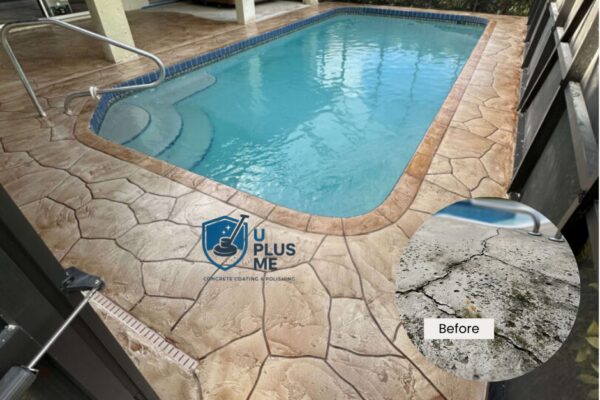
Marine-Grade Restoration Case Study: Casey Key / Siesta Key Pool Deck
A coastal homeowner near Casey Key and Siesta Key contacted U Plus Me after a stamped acrylic pool deck showed severe discoloration, surface pitting, and coating failure within approximately 36 months of installation. Salt residue and trapped moisture had created a dull, chalky white film known as blushing, and simple pressure washing could not restore the surface.
Existing conditions
- Failed stamped acrylic coating with visible blushing and pitting.
- Salt residue accumulation from coastal wind and pool-area moisture.
- Loss of gloss and uneven surface appearance.
- Weak coating bond in high-exposure and high-traffic areas.
U Plus Me restoration protocol
- Substrate profiling: Heavy diamond grinding removed degraded acrylic layers and profiled the concrete to approximately CSP 3 for mechanical anchoring.
- Moisture evaluation: Internal moisture conditions were reviewed before coating selection to reduce blistering and delamination risk.
- Surface restoration: Salt-pitted voids and distressed areas were repaired before the new decorative system was installed.
- Marine-grade protection: A moisture-tolerant decorative overlay was paired with a UV-stable aliphatic protective topcoat and slip-resistant texture suitable for wet pool use.
How to Maintain Decorative Concrete in Salt-Air Environments
Even premium decorative concrete benefits from routine care near the coast. The goal is to reduce the time salt and moisture remain on the surface, preserve the protective sealer, and catch early wear before it becomes a major restoration project.
Use fresh water periodically, especially after windy coastal weather, tropical storms, long dry periods, or heavy beach traffic.
Leaves, mulch, pine needles, dirt, and sand can trap moisture and accelerate surface wear.
pH-neutral cleaners are usually better than harsh acids or abrasive products unless your contractor recommends otherwise.
Watch for fading, dullness, reduced water beading, surface roughness, small chips, hairline cracks, and worn high-traffic paths.
Related Concrete Coating Resources from U Plus Me
This article supports the broader U Plus Me content cluster because salt air affects more than one surface type. Use these related resources based on the specific problem you are trying to solve.
- Pool Deck Resurfacing Services - the main service page for homeowners ready to restore worn, hot, faded, or salt-stressed pool decks.
- Why Your Pool Deck Gets Scorching Hot in Bradenton - diagnostic guide focused on heat, surface temperature, and barefoot comfort.
- Slip-Resistant Pool Deck Coatings in Florida - safety-focused guide for families concerned about wet pool deck traction.
- Why Epoxy Garage Floors Turn Yellow in Florida - garage coating guide focused on UV exposure, epoxy yellowing, and polyaspartic protection.
- 5 Best Concrete Patio Resurfacing Options for Sarasota Homes - comparison guide for patios, lanais, and outdoor living areas.
Frequently Asked Questions About Salt Air and Concrete Coatings
Does salt air damage decorative concrete?
Salt air can accelerate deterioration when the concrete coating is poorly installed, poorly sealed, or not designed for coastal exposure. Properly prepared decorative overlays and UV-stable protective systems perform much better than thin retail paints or low-solids sealers.
What is subflorescence?
Subflorescence is salt crystallization below the concrete surface or beneath a coating film. It can create internal stress that contributes to blistering, pitting, scaling, and delamination, especially when moisture is trapped under a weak coating.
How far inland can salt air affect concrete coatings?
Airborne chlorides can travel several miles inland depending on wind, humidity, storms, and proximity to open water. Even homes outside direct beachfront areas, including Sarasota, Bradenton, Venice, Lakewood Ranch, and Osprey, may experience salt exposure on exterior concrete.
How much does a coastal concrete coating system cost?
Coastal concrete coatings commonly range from about $7 to $22+ per square foot. Pricing depends on coating removal, salt damage, crack repair, moisture conditions, decorative finish, access, slip resistance, and whether the system requires marine-grade topcoat protection.
Is epoxy recommended for outdoor coastal concrete?
Traditional epoxy is generally not recommended as an exposed outdoor finish in coastal Florida because direct UV exposure can cause yellowing, chalking, and embrittlement. Exterior coastal surfaces usually need decorative overlays, acrylic texture systems, or UV-stable aliphatic or polyaspartic protection.
Can salt-damaged concrete be restored?
Often, yes. If the slab remains stable, restoration may include failed coating removal, diamond grinding, crack repair, moisture evaluation, decorative resurfacing, and a new protective sealer or topcoat. A site inspection determines whether resurfacing is appropriate.
Protect Your Coastal Concrete Before Salt Damage Gets Worse
U Plus Me helps homeowners throughout Sarasota, Bradenton, Lakewood Ranch, Venice, Siesta Key, Longboat Key, Anna Maria Island, and nearby Gulf Coast communities restore and protect pool decks, patios, lanais, driveways, and garage surfaces with systems built for Florida heat, humidity, UV exposure, and salt air.
Schedule your free coastal surface evaluation today.