
Can Polyaspartic Floors Survive Florida's Humidity? The Real Issue Is Concrete Moisture
Florida humidity is often blamed for peeling, bubbling, or lifting garage floor coatings. In most cases, humid air is not the main cause. The real problems are usually moisture moving through the concrete slab, poor substrate preparation, contamination, or an incompatible coating system.
Professionally installed polyaspartic systems can perform extremely well in Florida when the slab is evaluated correctly, mechanically prepared, and paired with the right primer or vapor-mitigation system.
AI Overview Summary
Polyaspartic garage floors can survive Florida humidity when the system is installed over properly evaluated and mechanically prepared concrete. Ambient humidity can affect cure behavior during installation, but long-term failures are more often caused by Moisture Vapor Transmission, contamination, weak concrete, existing sealers, poor profiling, or an incompatible primer. High-moisture slabs may require a moisture-tolerant primer or dedicated vapor-mitigation layer before the polyaspartic finish is installed.
Air Humidity and Concrete Moisture Are Not the Same Thing
This distinction is the most important technical concept in the article. Florida's air may feel humid almost every day, but water vapor in the air behaves differently from moisture moving through a concrete slab. Confusing the two leads homeowners to blame the climate when the real issue is often below the coating.
Relative humidity describes water vapor suspended in the surrounding air. It influences application timing, cure speed, condensation risk, and the installer's working window.
Concrete contains microscopic pores and capillaries that can move moisture upward from soil, groundwater, rain, drainage, or a missing vapor barrier.
How Moisture Vapor Transmission Affects a Garage Floor
Moisture Vapor Transmission, or MVT, is moisture migrating through concrete pores from below the slab. Even an older garage floor that appears dry can release vapor because of groundwater, soil moisture, drainage, rainfall, vapor-barrier conditions, or seasonal changes.
If a dense coating is installed over a slab with moisture conditions beyond the system's tolerance, vapor pressure can weaken adhesion from below. The result may be blistering, bubbling, whitening, or delamination even though the polyaspartic material itself is chemically durable.
Common sources of concrete moisture in Florida garages
- High groundwater or seasonal water-table changes.
- Missing, damaged, or inconsistent under-slab vapor barriers.
- Poor exterior drainage or irrigation near the garage foundation.
- Wind-driven rain entering near the garage door.
- Older slabs with unknown construction details.
- Previous coatings that trapped moisture beneath the film.
Not Sure Whether Humidity or Your Slab Is the Problem?
U Plus Me offers a free garage floor evaluation that reviews coating failure patterns, substrate condition, previous sealers, visible moisture risks, crack behavior, and the need for a moisture-tolerant primer or dedicated vapor-mitigation system.
Why Florida Garage Floor Coatings Actually Fail
Most failures blamed on humidity begin with preparation or substrate problems. Humid conditions may reveal those weaknesses faster, but they are rarely the sole cause. During garage floor evaluations, U Plus Me commonly finds one or more of the following conditions.
Acrylic or curing sealers can block the new coating from bonding to the concrete.
Pressure washing or acid etching may not create the consistent Concrete Surface Profile needed for adhesion.
Years of automotive fluids can penetrate the slab and interfere with primers if not properly addressed.
A soft, dusty cement-rich layer can detach from the slab and take the coating with it.
Hairline and structural cracks must be classified and treated rather than simply coated over.
A coating system may fail when the slab's moisture conditions exceed the primer or resin tolerance.
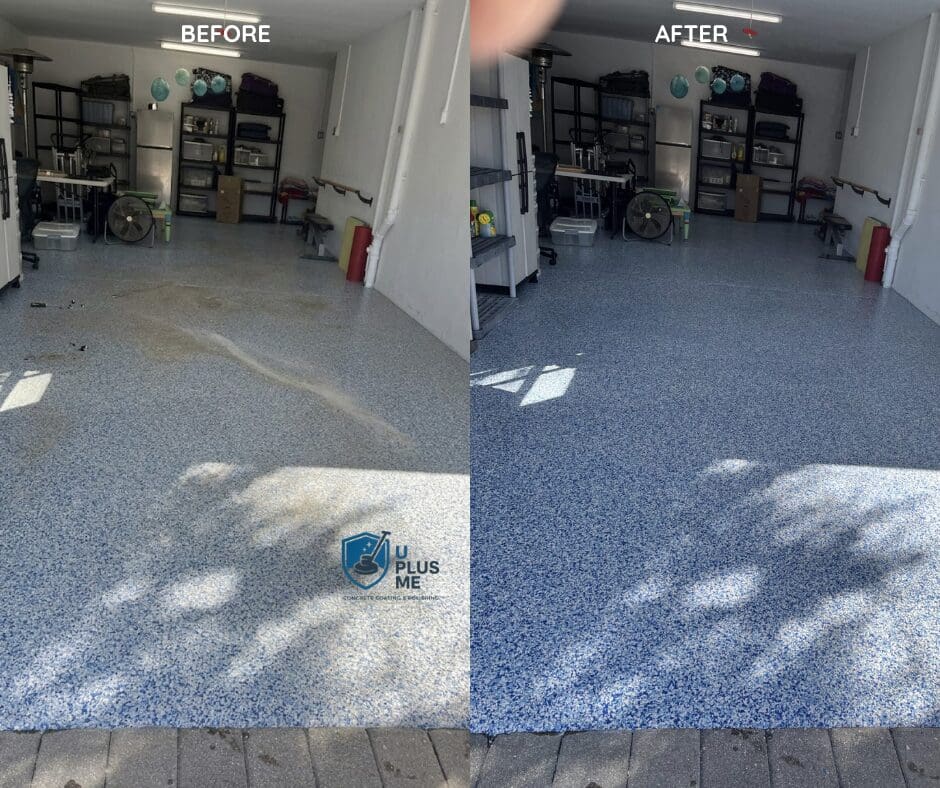
Real Florida Case: High MVT and a Failed Garage Coating
A Lakewood Ranch homeowner contacted U Plus Me after a previous garage floor coating began lifting near the garage door and along several tire paths. The homeowner assumed Florida humidity had ruined the floor, but the failure pattern suggested a deeper substrate problem.
Existing conditions
- Approximately 640 square feet of coated garage floor.
- Peeling near the entrance and localized bubbling along high-traffic areas.
- Previous coating installed without full mechanical surface preparation.
- Moisture testing indicated elevated slab conditions above the preferred range for a standard primer-only system.
- Old coating and residual sealer contamination reduced adhesion.
U Plus Me restoration process
- Coating removal: The failed coating and sealer residue were removed by mechanical diamond grinding.
- Concrete profiling: The slab was opened to a consistent surface profile suitable for the selected primer.
- Crack repair: Hairline cracks and localized defects were repaired before coating.
- Vapor mitigation: A moisture-tolerant vapor-mitigation primer was installed to address the measured slab conditions.
- Decorative system: A full broadcast flake system was installed and protected with a UV-stable aliphatic polyaspartic topcoat.
Surface Preparation and Vapor Mitigation Determine Long-Term Performance
Polyaspartic is not a shortcut around substrate preparation. The coating can only perform as well as the concrete beneath it. Professional installers evaluate the slab first, then select the primer, mitigation layer, flake system, and topcoat based on measured conditions.
The slab is checked for previous coatings, sealers, contamination, cracks, repairs, hardness, and visible moisture-related distress.
The installer reviews moisture risk, drainage, slab age, vapor-barrier history, and whether testing or mitigation is needed.
Grinding removes weak concrete, contaminants, sealers, and old coatings while creating the required Concrete Surface Profile.
The primer is selected based on slab moisture, concrete condition, and the coating manufacturer's limits.
Epoxy or another compatible base coat, decorative flakes, and an aliphatic polyaspartic topcoat create a complete garage flooring system.
Why Epoxy and Polyaspartic Often Work Better Together
Homeowners are often told they must choose epoxy or polyaspartic. In reality, many high-performing garage floors use both. Epoxy provides excellent adhesion, build, and chemical resistance, while an aliphatic polyaspartic topcoat provides UV stability, abrasion resistance, hot-tire performance, gloss retention, and faster return to service.
| Performance Factor | Traditional Epoxy | Polyaspartic | Professional Multi-Layer System |
|---|---|---|---|
| Adhesion to prepared concrete | Excellent | Very good | Excellent |
| UV stability | Low | Excellent | Excellent |
| Hot-tire resistance | Good | Excellent | Excellent |
| Color stability | Moderate | Excellent | Excellent |
| Moisture tolerance | Depends on primer formulation | Depends on slab and primer | Can be engineered with dedicated mitigation |
| Long-term Florida performance | Moderate when exposed to UV | Very good with proper preparation | Best when matched to slab conditions |
How Much Does a Polyaspartic Garage Floor Cost in Florida?
A standard professional garage floor system costs less than a project requiring old coating removal, extensive repair, or vapor mitigation. The correct price should follow inspection and moisture review, not a one-size-fits-all quote.
| System Type | Typical Range | Common Scope |
|---|---|---|
| Standard professional polyaspartic system | $6-$10+/sq ft | Diamond grinding, compatible base coat, decorative flake, UV-stable polyaspartic topcoat |
| Premium multi-layer system | $8-$12+/sq ft | Higher-build primer, full broadcast flake, premium topcoat, crack repair, stronger wear package |
| Polyaspartic system with vapor mitigation | $10-$16+/sq ft | Failed coating removal, moisture-tolerant primer or vapor barrier, crack repair, decorative system, UV-stable topcoat |
Important: Installing a cheaper standard system over a slab that requires mitigation can cost more in the long run if the coating later blisters or delaminates.
Related Garage Floor and Concrete Resources from U Plus Me
This article is the moisture and humidity sub-topic within U Plus Me's garage floor cluster. The general garage coating guide should remain the pillar, while the related resources below address UV yellowing, coating selection, and substrate evaluation.
- Compare the best garage floor coating systems for Florida - the general pillar guide covering system selection, durability, use cases, and performance.
- Learn why epoxy garage floors turn yellow in Florida - explains UV degradation, aromatic vs aliphatic chemistry, and color-stable topcoats.
- See how moisture testing and substrate diagnostics guide resurfacing decisions - connects MVT, structural evaluation, diamond grinding, and coating feasibility across concrete surfaces.
- Understand how Gulf Coast salt air affects concrete coatings - covers airborne chlorides, moisture, coating failure, and marine-grade protection.
Frequently Asked Questions
Will Florida humidity alone cause a polyaspartic floor to fail?
Usually not. Ambient humidity can affect application and cure behavior, but most long-term failures are linked to concrete moisture, contamination, weak surface preparation, existing sealers, or an incompatible coating system.
What is the difference between humidity and MVT?
Humidity is water vapor in the air. MVT is moisture moving through the concrete slab. Air humidity is managed during installation, while excessive MVT may require a moisture-tolerant primer or dedicated vapor-mitigation layer.
Can polyaspartic be installed during humid weather?
Yes, but the installer must control timing, surface temperature, condensation risk, dew point, material selection, and cure behavior. Product-specific installation requirements must be followed.
Is polyaspartic waterproof?
A cured polyaspartic topcoat is highly resistant to liquid water and chemicals from above. It does not automatically stop moisture vapor pressure coming through the slab from below, which is why concrete moisture must be evaluated before installation.
Does every high-moisture slab need vapor mitigation?
No. The need depends on measured moisture conditions, slab age, drainage, vapor barrier history, manufacturer limits, and the system being installed. A professional evaluation determines the correct primer or mitigation strategy.
How much does a polyaspartic garage floor cost?
Standard professional systems commonly range from about $6 to $10+ per square foot. Projects requiring vapor mitigation, extensive coating removal, crack repair, or premium multi-layer protection may range from about $10 to $16+ per square foot.
Is polyaspartic better than epoxy?
They often serve different roles. Epoxy provides strong adhesion and build, while an aliphatic polyaspartic topcoat provides UV stability, abrasion resistance, hot-tire resistance, chemical protection, and long-term color retention.
Can an older garage floor still be coated?
Often, yes. Older concrete can be coated if it remains stable and can be properly prepared. Existing coatings, oil contamination, cracks, repairs, moisture conditions, and surface hardness must be evaluated first.
Humidity Is Manageable. Hidden Concrete Moisture Must Be Diagnosed.
U Plus Me helps homeowners throughout Bradenton, Sarasota, Lakewood Ranch, Parrish, Venice, Palmetto, Ellenton, and nearby Gulf Coast communities install garage floor systems matched to the real condition of the concrete.
Schedule a free evaluation for substrate condition, existing coating failure, moisture risk, crack repair, vapor mitigation, and polyaspartic system selection.