
Can a Decorative Concrete Overlay Be Repaired Without Replacing It?
Every week we get a call that starts the same way: "There's a crack in my pool deck, does the whole thing need to be torn out?" Most of the time, the answer is no. Most of the time.
Decorative concrete overlays fail in a lot of different ways in Florida hairline cracking, chipping at the edges, a hollow sound when you tap certain spots, peeling near the pool coping and each points to a specific cause and a different answer about structural viability.
Quick Summary
A decorative concrete overlay can often be repaired rather than replaced when the damage is localized isolated cracking, surface chipping, or minor delamination in a defined area and the underlying slab is structurally sound.
Replacement becomes the better option when damage is widespread, when there's active substrate movement, when moisture is trapped beneath large sections of the overlay, or when the original installation failed due to poor bonding across most of the surface. Professional evaluation sound testing, moisture testing, and crack assessment is what determines which category a given overlay falls into, and Florida's humidity, UV exposure, and pool chemical environment all factor into that diagnosis.
Understanding Decorative Concrete Overlays and Targeted Repairs
A decorative concrete overlay is a thin layer of cement-based material typically a fraction of an inch to about an inch thick applied over existing concrete to add texture, color, and pattern, commonly used on pool decks, patios, and driveways throughout the Sarasota area.
Overlays are bonded to the original slab rather than being a standalone structure, which is exactly why their long term performance depends so heavily on what's happening underneath them. A stamped, textured, or knockdown overlay is only as durable as its bond to the base concrete and as stable as the slab it's sitting on. When people ask why their five year old overlay is already cracking while their neighbor's ten year old overlay looks fine, the answer is almost always in the substrate condition and the original prep work, not the overlay material itself.
What Is Decorative Concrete Overlay Repair specifically?
Decorative concrete overlay repair is the process of removing and restoring damaged sections of an existing overlay rather than the entire surface by cutting out unsound material, stabilizing the substrate if needed, reapplying overlay material, and recreating the original texture and color to blend with the surrounding surface.
Repair is fundamentally different from resurfacing an entire slab. It's targeted work: identifying exactly where the bond has failed or the material has degraded, removing only that section, and matching it back into the existing surface. Done well, a repaired section should be difficult to spot once it's sealed. Done poorly which is common with DIY patch kits it shows up as an obvious patch with a different texture, a different color, and a visible seam for years afterward.
How Professionals Decide Between Repair and Replacement
Contractors decide between repair and replacement based on the extent of the damage, whether the substrate itself is stable, how much of the surface is affected, and whether the cause of the original failure has been resolved repairing over an unaddressed cause, like ongoing moisture intrusion, typically leads to the same failure recurring.
The evaluation isn't just "how bad does it look." A small crack can be a red flag for slab movement, and widespread surface chipping can sometimes be a surface only issue that's straightforward to fix. What actually matters is diagnosis: sound testing to map hollow or delaminated areas, moisture testing to rule out vapor transmission problems, and an assessment of whether cracks are stable hairline cracks or active structural movement.
In our experience across Sarasota, Bradenton, and Lakewood Ranch homes, overlays installed without proper substrate prep in the first place are the ones most likely to need full replacement, because the bond failure tends to be widespread rather than isolated to one section.
Did you know that... If your project involves general architectural trade-offs, see our comparison on Concrete Overlay vs Pool Deck Replacement (Sarasota & Bradenton) which walks through macro-level budgeting, full tear-outs, and structural slab overhauls. This guide, however, covers the technical repairing and patching of a failing decorative overlay skin itself.
Need an Honest Evaluation of Your Pool Deck or Patio?
Don't guess whether you need a full replacement or a simple structural spot repair. We perform comprehensive diagnostics to uncover the true cause of cracking or hollow spots.
Signs Your Decorative Overlay Can Be Repaired vs. Replaced
An overlay is generally repairable when damage is isolated to specific areas, the surrounding overlay still has a strong bond, the substrate underneath is stable, and the cause of the damage impact, isolated moisture, a single expansion joint issue can be identified and corrected before repair.
- Cracking is limited to a small, defined area.
- Tapping the surface produces a solid sound everywhere except the damaged zone.
- The overlay elsewhere is firmly bonded with no lifting.
- Discoloration or fading is cosmetic, not deep delamination.
- Damage stems from a known, one-time cause (e.g., dropped heavy object).
- The original installation layer was soundly prepped.
- Moisture testing doesn't show widespread vapor issues.
- Sound testing reveals hollow areas across a large portion of the slab.
- Cracks continue to appear in new locations even after repairs.
- Moisture testing shows severe vapor transmission issues across the slab.
- The substrate structural concrete itself has deep shifting or structural faults.
- The overlay is widely delaminating and curling up along edges.
The Most Common Causes of Decorative Overlay Failure in Florida
In Florida, the most common causes of decorative overlay failure are inadequate surface preparation during original installation, moisture vapor transmission from the substrate, thermal expansion and contraction from intense sun exposure, pool chemical exposure on deck overlays, and substrate movement at expansion joints that wasn't properly accounted for in the original design.
Poor bond from inadequate prep is the one we see most often an overlay installed over concrete that wasn't properly ground or profiled will often show delamination within a few years, sometimes appearing first as a hollow sound before any visible cracking shows up. Moisture vapor transmission is a close second, particularly on older slabs without a vapor barrier; trapped moisture pushes against the overlay from underneath and eventually breaks the bond.
UV degradation shows up as fading and, over time, surface chalking Florida's sun is simply harder on decorative finishes than most climates. Pool deck overlays face an added factor: chlorine and other pool chemicals can accelerate surface wear and staining near the coping if the sealer isn't maintained.
Professional Inspection Checklist
A professional decorative overlay inspection includes sound testing to map hollow or delaminated areas, moisture testing of the substrate, visual assessment of crack patterns and movement, evaluation of the existing sealer condition, and a check of surface contamination that could affect repair bonding. What we check on-site:
- Sound testing: Tapping or dragging a specialized tool across the surface to identify hollow-sounding sections where the overlay has separated from the substrate below.
- Moisture testing: Checking for vapor transmission, especially on pool decks and ground-level patios where moisture exposure is highest.
- Crack assessment: Determining whether cracks are stable hairline cracks in the overlay itself or reflect active movement in the substrate concrete.
- Sealer condition: Old, failing sealer needs to be fully removed before any repair, or the new material won't bond properly.
- Surface contamination: Assessing oil, efflorescence, or algae growth common on shaded Florida pool decks that would interfere with adhesion.
- Expansion joint condition: Checking whether joints are functioning as designed or have become a point of recurring cracking.
Real Sarasota Restoration Example
Original Condition
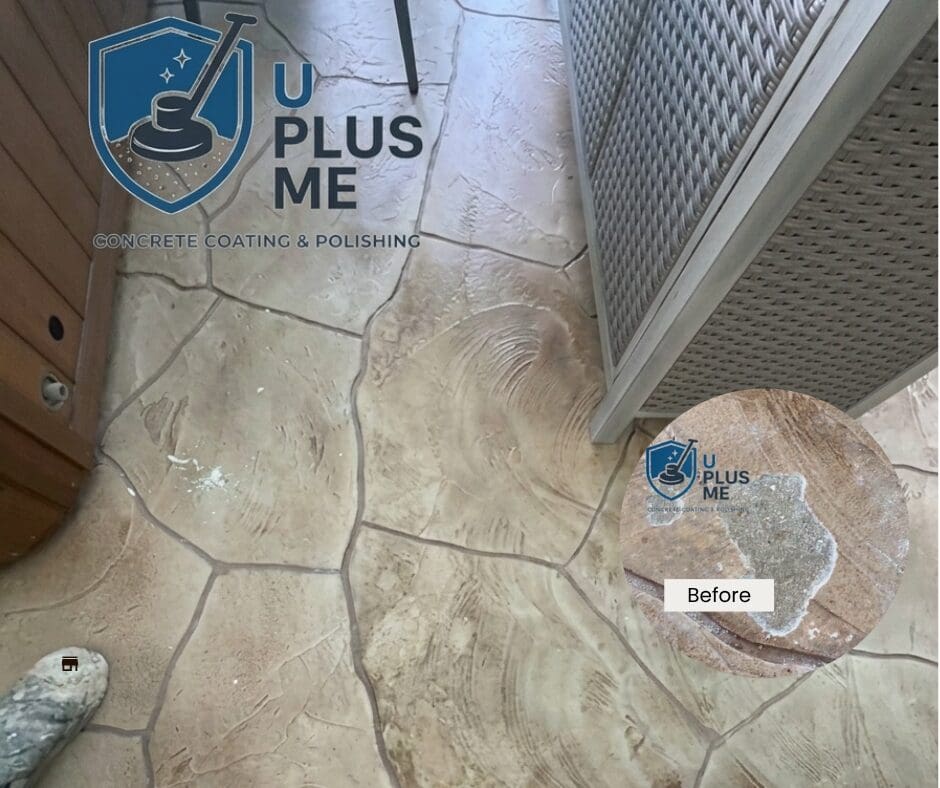
The homeowner had a stamped, cool-deck-style pool deck overlay installed about seven years earlier, roughly 400 square feet around the pool in Sarasota, FL. Two areas near the shallow end steps had begun sounding hollow underfoot, with visible hairline cracking radiating from one spot near the coping. The rest of the deck looked and sounded fine. Their concern was whether this meant the entire deck needed to be redone.
Professional Inspection & Diagnosis
We sound-tested the full deck and found the hollow area was confined to roughly a six-foot section near the steps not spread across the deck. Moisture testing in that zone showed elevated readings consistent with water intrusion at a nearby expansion joint that had failed. The rest of the deck tested normally for both sound and moisture. The existing sealer was in reasonably good shape outside the damaged area, and there was no sign of substrate cracking beyond the affected zone.
We recommended targeted repair, not full replacement. The damage was clearly isolated and traceable to one cause a failed expansion joint allowing water to migrate under a section of overlay rather than a systemic bonding or installation problem across the whole deck. Replacing 400 square feet of overlay to fix a six-foot problem wouldn't have made sense once the actual cause was identified and could be corrected.
Repair Process & Final Result
We removed all delaminated overlay material in the affected zone, extending slightly past the visibly damaged area to reach a solid bond. The failed expansion joint was rebuilt to properly manage water and movement going forward. The substrate was mechanically prepped, new overlay material was applied and feathered into the surrounding edge, and the cool-deck texture was recreated by hand to match the surrounding finish. Color blending took an extra pass since the existing deck had visibly lightened from seven years of pool chemical and UV exposure matching the original spec color would have made the repair stand out rather than disappear.
Once sealed, the repaired section was difficult to distinguish from the surrounding deck at normal viewing distance. The homeowner avoided the cost and disruption of a full deck replacement, and because the underlying cause was corrected, the repair addresses the actual problem instead of masking it temporarily.
How Decorative Concrete Overlay Repairs Are Performed
Professional overlay repair involves removing all unsound and delaminated material down to solid substrate, mechanically preparing the exposed area, stabilizing any cracks, reapplying overlay material feathered into the existing surface, recreating the original texture, color-matching to the surrounding finish, and applying a protective sealer once cured.
Every bit of loose, hollow, or delaminated overlay gets removed—not just the visibly cracked section. Leaving any compromised material at the edges of a repair is one of the most common reasons patch repairs fail again within a year or two.
The exposed area gets ground and profiled the same way a full overlay installation would be prepped, because the repair needs the same quality of bond as the original surface should have had.
If the damage traces back to a crack in the substrate, that crack gets addressed first—typically with a flexible filler or pinning, depending on whether there's any movement before new overlay material goes down over it.
New material is applied and feathered into the surrounding edge so there's no visible ridge or step where old meets new. Whatever texture the original overlay has stamped, knockdown, broom, or a custom pattern has to be recreated by hand in the repaired section to match.
We color-match to how the existing surface actually looks now after years of sun exposure, not to the original formula. Once cured, the repaired area and surrounding surface get resealed to lock in protection and even out sheen.
Repair vs. Replacement Feasibility Matrix
| Damage Type | Repair Feasibility | Recommended Solution | Expected Longevity |
|---|---|---|---|
| Isolated hairline cracking | High | Targeted repair & stabilization | Similar to surrounding overlay |
| Localized chipping / impact | High | Targeted patch & texture match | Similar to surrounding overlay |
| Small hollow / delaminated area | Moderate-High | Cut back to sound edges, fix source | Good, if under-slab cause is resolved |
| Widespread delamination | Low | Full overlay removal and replacement | Full replacement lifespan |
| Active structural substrate cracking | Low | Address structural engineering slab first | Depends entirely on slab stabilization |
Looking for Garage Floors instead? If you are looking into high-durability floor resin systems rather than exterior concrete overlays, check out our resource on Can Polyaspartic Floors Survive Florida Humidity? which covers interior concrete slab moisture, vapor mitigation, and garage coatings.
Frequently Asked Questions
Can decorative concrete overlays really be repaired without replacing everything?
Yes, in many cases. When damage is isolated and the substrate is stable, professional repair can restore both appearance and function without replacing the entire surface.
Will repaired areas match the original weathered finish?
A skilled contractor can closely match texture and color, though matching is done to the current, weathered appearance of the surrounding surface rather than the original installation color, since concrete changes over time under Florida sun and chemicals.
Why is my decorative concrete overlay peeling or failing near pool coping?
In Florida, the most common causes of decorative overlay failure are inadequate surface preparation during original installation, moisture vapor transmission from the substrate, thermal expansion from intense sun exposure, and pool chemical wear. Localized peeling can be repaired, but widespread peeling usually points to a broader bonding issue better addressed with full resurfacing.
How much does decorative overlay repair cost in Sarasota?
Cost depends heavily on the extent of damage, the texture being matched, and the underlying structural cause. A standard professional overlay installation typically ranges from $6 to $10+ per square foot, while custom targeted repair work involving failed coating removal, moisture barriers, and intricate hand-texturing blending ranges from $10 to $16+ per square foot depending on structural patch requirements. A free on-site evaluation is the most reliable way to get an accurate figure.
How long do decorative overlay repairs typically last?
When the underlying cause of the damage is identified and corrected (such as a leaking expansion joint or localized moisture drainage issue), a professional repair can perform comparably to the surrounding overlay for its remaining lifespan. Repairs that don't address the root cause tend to fail again within a couple of seasons.
Not Sure Whether Your Decorative Overlay Needs a Repair or a Full Replacement?
Guessing from a crack or a hollow spot alone isn't enough—it takes sound testing, moisture testing, and an honest look at what's actually happening underneath.
Schedule a free decorative overlay inspection for your Sarasota, Bradenton, or Lakewood Ranch property, and we'll give you a clear, honest recommendation based on what your surface actually needs—not the most expensive option by default.